My 2025 YouTube Journey: 488K Views, 100 Videos, and What the Data Taught Me
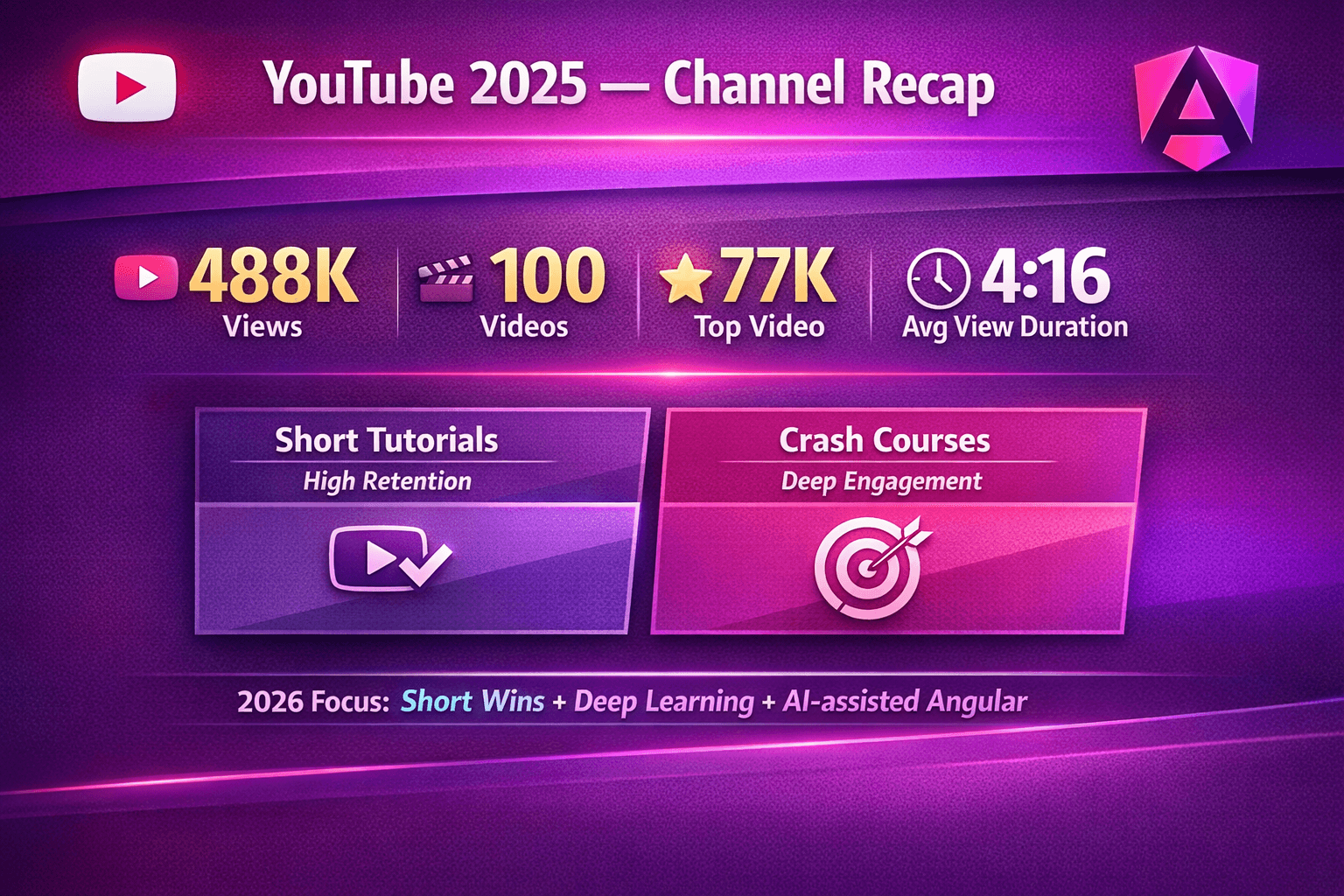
As I sit here on New Year's Eve looking back at 2025, I'm honestly blown away. 488,083 views across 100 videos. That's nearly half a million times someone decided my Angular content was worth their time.
To everyone who watched, commented, liked, or shared—thank you. Seriously. This wouldn't exist without you.
But beyond the gratitude (which is real and deep), I wanted to share something more interesting: what the data taught me about you, about content creation, and about where we're heading in 2026.
The Numbers Tell Two Stories
When I exported my 2025 YouTube analytics into a spreadsheet (yes, I'm that kind of nerd), a pattern emerged that completely changed how I think about content.
Story #1: The Quick Win Seekers
My shorter, focused tutorials—the 10-20 minute videos on specific problems—consistently hit 20-35% average view percentages.
Videos like:
- "The New Super-Simple Way to Theme Angular Material" (19% retention, 24K views)
- "Combining Angular Material & Tailwind CSS" (21% retention, 11K views)
- "How to create Sleek Angular Material Forms" (28% retention, 8K views)
- "This Angular Directive Eliminated 70% of My Material Form Error Code" (25% retention, 2.7K views)
These videos solve a specific problem. You search for it, you watch it, you implement it, you move on. Mission accomplished.
What this tells me: Most of you are busy developers working on real projects. You don't have time for hour-long lectures. You need actionable solutions you can implement in the next 30 minutes.
Story #2: The Deep Dive Builders
But here's what really surprised me.
My longer crash courses and series—the 40+ minute deep dives—have much lower average retention (8-15%). That makes sense, right? Longer videos naturally have more drop-off.
But.
The Modern Angular E-Commerce Crash Course hit 77,739 views—my most popular video of the year. At 79 minutes long, the average viewer watched about 7-8 minutes.
That means while many people clicked away early, there's a core group of you who watched 30, 40, or even the full 79 minutes. You're following along step-by-step, building the project with me, taking notes, pausing to code.
The same pattern appears in my dashboard series, the dynamic form builder tutorials, and the Firebase integration videos.
What this tells me: There's a subset of viewers who don't just want quick answers—they want to understand the why behind the how. They're building real applications and need comprehensive guidance.
Why Both Groups Matter Equally
Here's the thing: I could look at this data and think, "Well, short videos get better retention. I should only make short videos."
But that would be a mistake.
Because those of you watching the full 79 minutes? You're the ones actually building things. You're applying what you learn. You're the ones who email me months later saying "I used your e-commerce tutorial as a foundation for my client project" or "I got a job because I could explain the patterns you taught."
You inspire me to create those comprehensive series even when the "numbers" say I shouldn't.
At the same time, those quick-win videos help hundreds of developers solve immediate problems. That matters too.
So in 2026, I'm not choosing. I'm embracing both.
What's Changing in 2026
YouTube: Doubling Down on Quick Wins
I'm committing to more short, actionable tutorials (10-15 minutes) on:
- Signal Forms and the new form primitives
- Resource API patterns for async data
- Angular Material theming and customization
- State management with NgRx Signal Store
- Angular + AI productivity workflows (Cursor integration, prompting strategies)
- Common pain points (animations, forms, routing, deployment)
These will be highly focused. One problem, one solution, implemented start to finish.
My Own Platform: The Deep Dives
Here's where it gets interesting.
With Udemy being acquired and rebranded, and seeing the limitations of existing learning platforms, I'm building my own Angular learning platform.
This is a big investment, but it means:
- Full control over the learning experience (no algorithmic constraints on what I can teach)
- Better course structure (proper prerequisites, progressive complexity, real project progression)
- Direct connection with you (no platform taking 50%+ and controlling communication)
- Courses designed how they should be—for learning, not for gaming platform metrics
The comprehensive crash courses? The multi-part series? The deep architectural discussions? Those will live there.
I'm in early stages, but I'd love your input:
- What's missing from existing learning platforms?
- Would you value community features? Live office hours? Code reviews?
- What would make a platform worth paying for versus free YouTube content?
The Trends That Shaped 2025
Looking at what resonated this year, a few themes stand out:
1. Signal Everything
The Angular Signals ecosystem matured significantly. Videos on Signal Forms, Resource API, and NgRx Signal Store consistently performed well.
The big question everyone's asking: "Do we even need RxJS anymore?"
For many CRUD applications, the answer is increasingly "not really." Signals + Resource API handle most async patterns more intuitively. Of course, RxJS has its place in handling race conditions and async events.
2. Angular Material Theming Evolution
With the new M3 token system in Angular Material v18-19, theming went from "complicated and hacky" to "actually straightforward."
My theming videos this year got some of the highest engagement percentages. Developers are hungry for modern, maintainable styling approaches. The new Angular ARIA components are also a very nice addition for creating your own styled components with all of the accessibility features that are needed.
3. Full-Stack Angular
The e-commerce series showed something important: the biggest gap isn't writing Angular code—it's connecting it to a real backend.
Authentication, database integration, payment processing, deployment—these are the pieces where developers get stuck. More full-stack content is coming in 2026. With AI increasing productivity nowadays, there's no reason why you need to stay stuck as a front-end only developer - AI can ease your transition into a more full stack role and get projects done faster!
4. AI-Assisted Development
I've been using Cursor, v0.app and other AI coding tools extensively in my work this year, and it's genuinely transforming how I build Angular applications.
The videos I created on Cursor + Angular integration sparked incredible discussions. Some of you love AI assistance. Others are skeptical. Many are somewhere in between, trying to figure out the right balance.
Questions I'm exploring:
- Should we let AI generate entire components, or just assist with boilerplate?
- How do you balance AI speed with code quality and understanding?
- What's the role of AI in testing Angular applications?
- Are AI-generated unit tests actually useful, or do they create false confidence?
I want to create more AI-assisted Angular tutorials in 2026, but I need your input: What would actually help you? Code generation workflows? Debugging with AI? Refactoring legacy code? Test automation?
My Top 5 Videos You Might Have Missed
Looking back at the year, here are five videos that deserve more attention:
-
The New Super-Simple Way to Theme Angular Material (v19) - 24K views, 19% retention
- The Material theming API finally makes sense. This is the approach I use in all my projects now.
-
Angular Material Customizable Dashboard Series - 22K+ views
- Three-part series on building drag-and-drop dashboards. This became the foundation for my dashboard template product.
-
Angular Signals Crash Course - Build Full CRUD app - 18K views
- Comprehensive introduction to building with signals. Still relevant and will be for years.
-
Combining Angular Material & Tailwind CSS - 11K views, 21% retention
- Best of both worlds. Use Material components for complex UI, Tailwind for layout and utilities.
-
Why NgRx Signal Store is My New Default - 5.8K views, 23% retention
- Lower view count but high retention. If you're doing state management in 2026, watch this. I plan to create much more content about my favorite Signal Store in the coming year.
Bonus: If you're just getting started with Angular, the Modern Angular E-Commerce Crash Course (77K views) is still the best place to begin. It covers modern patterns, routing, forms, HTTP, and more—all in one comprehensive project.
What I Need From You
This blog post would be incomplete without asking for your help.
I'm shaping 2026 content right now, and I need to know:
-
What Angular challenges are you facing? What's the one thing you wish you understood better?
-
What would make a learning platform worth joining? Beyond just videos—what features, structure, or community aspects matter?
-
How are you using AI in your Angular development? What's working? What's not? What tutorials would help?
-
What's one 10-minute tutorial that would save you hours next week?
Leave a comment below or email me directly. I read everything, and your feedback directly shapes what I create.
Code Templates and Resources
Speaking of building real applications—this year I also launched premium code templates alongside the free tutorials.
If you've been considering the Angular Material Dashboard Template or the Modern E-Commerce Code Bundle, they're available at my shop. If you're reading this in 2025, you can use my YEAR2025 coupon to avail the year end 30% sale!
The dashboard template includes everything from my dashboard series plus Firebase sync, dark mode, beautiful animations, and production-ready features. Over 200+ developers and owners have used it to skip weeks of setup.
The e-commerce bundle includes the complete frontend code plus the Firebase backend integration with Stripe payments—everything you need to understand how the full stack connects.
Every purchase supports the channel and helps me build that learning platform we talked about.
Thank You
2025 was transformative. Not just in views or subscribers, but in understanding what actually helps developers build better Angular applications.
In all honesty though, it was also a bit tough for me as I grappled with transitioning myself from primarily a freelance developer to more of an educator/trainer.
I'm grateful for every comment, every question, every "this helped me" message. That's why I do this.
Here's to 2026. More Angular. More learning. More building together.
Let's keep building,
Zoaib Khan
Senior Software Engineer & Angular Educator
P.S. - If you missed it, I just released a complete Firebase + Stripe backend integration video on December 24th. It's one of the most comprehensive walkthroughs I've done, showing how all the pieces of a full-stack e-commerce app connect: Watch it here